
Certifications & expertise
Trained by Toyota, at the heart of the TPS
Since the start of my career, I have been trained by the very best TPS specialists: Toyota’s own teams, in France and in Japan.
The TPS (Toyota Production System) is the absolute global benchmark for industrial excellence. I studied it within the very first teams in France and Europe, then implemented it in the automotive, energy, precision engineering and luxury industries.
On this page: my certification, my training path, and the TPS explained simply, for those who are not yet familiar with it.
- of operational experience in industry
- 35years
- workshops led on the shop floor
- 1,000+
- corporate production systems created or deployed
- 4
- continents of operation
- 3
01The TPS explained
The TPS, explained simply
Born at Toyota in post-war Japan, driven by Taiichi Ohno, the Toyota Production System is a way of producing and managing: the best quality, at the lowest cost, in the shortest lead time, by drawing on the intelligence of the teams. In the West, it is often called “Lean”.
- 01
TPS = Toyota Production System
Toyota’s production system, which within a few decades became the model studied and adopted by manufacturers worldwide.
- 02
TPS = Lean: hunting down waste
Anything that does not add value for the customer is waste (muda): overproduction, waiting, transport, unnecessary motion, inventory, rework… The TPS teaches you to see it, then to eliminate it.
- 03
TPS = Work content / Takt time = number of workstations
Takt time is the pace of customer demand: available time divided by the quantity to produce. It lets you size a line precisely, with neither too many nor too few workstations.
- 04
TPS = Do, and you will understand
The TPS is not learnt in a classroom: it is practised on the shop floor, with the operators. Doing is how you understand, and how results come.
The language of the TPS
“Without standards, there can be no improvement.”
- Gemba現場
- The real place where value is created: the workshop, the line, the workstation.
- Muda無駄
- Waste: any activity that consumes resources without creating value for the customer.
- Kaizen改善
- Continuous improvement, step by step, driven by the people who do the work.
- Jidoka自働化
- Stopping at the first defect so that poor quality is never passed on: quality built into the process.
- Standardised work標準作業
- The best known way, today, to perform a task: the foundation of all improvement.
- Hoshin方針
- The needle that shows the direction: hoshin kanri deploys strategy at every level of the company.
02Certification & training
Trained in the TPS at the source
Continuous training, in direct contact with Toyota and with the experts who brought the TPS to Europe.
France
Renault’s very first TPS teams
Renault Group · JMAC
Studying and deploying the TPS basics at scale across the group’s European plants, with JMAC (Japan Management Association Consultants).
France · Europe
PSE, then the Faurecia Excellency System
Sommer Allibert · Faurecia
Within the first teams to study and deploy PSE (Production Systems Efficiency), then the FES, led by Freddy Ballé and coached by Alain Prioul.
Japan
Immersion at Toyota, in Nagoya
MARK IV · Sogefi
Immersion training at Toyota in Japan, and four years of coaching by Michael Ballé (ESG Consultant, Shingo Prize).
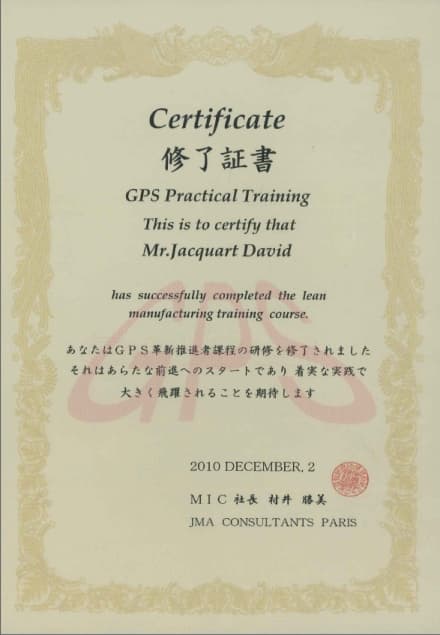
Certification · 2010
GPS Practical Training
MIC · JMA Consultants Paris
Lean manufacturing training course certificate, awarded on 2 December 2010.
03On the shop floor
The TPS as I practise it
A monthly meeting, operational projects, immediate results.
On the ground, with the operators
Projects are run at the gemba, with the people who do the work: they are the ones who know their workstation best.
Short but intense projects
A few days are enough to transform a workshop, when preparation is rigorous and the team is engaged.
Safety first
Safety and better working conditions are at the heart of every project.
Immediate results, systematic learning
Every project delivers measurable gains and leaves the teams with a method they can repeat.
Hoshin, a TPS tool
Literally, the compass needle that shows the direction to follow. Hoshin kanri, or “policy deployment”, aligns every level of the company on the same course.
One Hoshin = 1 day of preparation + 3 days of workshop
04Case study
A workshop transformed in 4 days
At an industrial client, March 2026: a Hoshin on a production workshop, with 1 day of preparation then 3 days of workshop with the teams. The result: production capacity rises sharply — and labour productivity rises with it!
×3
production capacity
from 1,000 to 3,000 parts per week
×2
direct labour productivity
from 3 to 6 PPH (parts per person per hour)
10
actions fixed during the workshop
mainly safety-related
- Before
- 3 operators, 10 parts/hour = 3 PPH · 1,000 parts/week
- After
- 5 operators, 30 parts/hour = 6 PPH · 3,000 parts/week
Every project is an opportunity to learn
- Beyond standardised work: accelerating flows.
- The logistics “little train”, a key element of revitalisation: operators who stay at their workstation, faster flows and controlled inventory, optimised layout.
- Budget, S&OP, master production schedule, master supply plan: one and the same story (normally!).
These results could be yours tomorrow
A first conversation helps me understand your context and identify the priority levers.